
Undergraduate degree programs
Our bachelor’s degree programs prepare you for a career in modern manufacturing engineering, manufacturing systems and robotics.
Bachelor’s degree programs

Manufacturing engineering, BS
This program is hands-on, project-based and equips students with practical skills to become innovative manufacturing engineers. Graduates are prepared for high-demand roles in design, production and quality assurance across industries, with strong job prospects and competitive salaries.

Robotics and autonomous systems, BSE
This program prepares students to design and implement advanced robotics and autonomous systems. With strong foundations in theory and application, graduates pursue careers in automation, aerospace, defense and more across industry and research sectors.
Additional pathways
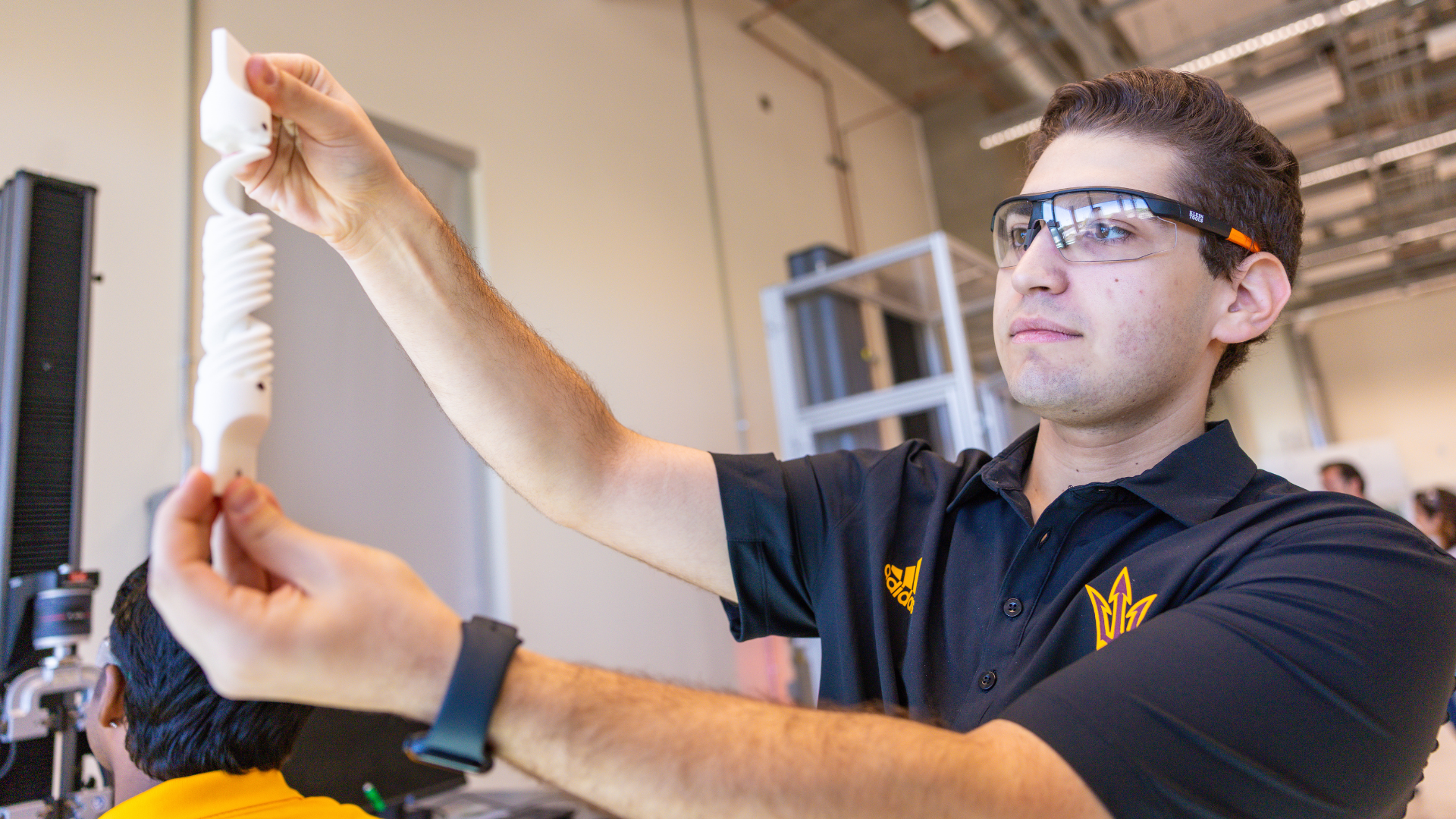
Manufacturing systems, BAS
The Bachelor of Applied Science program requires students to have completed an AAS degree in a related field from a regionally accredited institution. Through hands-on projects and industry-aligned coursework, the program explores manufacturing systems while building expertise in areas such as automation, robotics, digital design and fabrication, industrial data analytics, production management, quality assurance and smart manufacturing.

Physical artificial intelligence engineering in robotics and manufacturing, certificate
Unlock the future of intelligent machines. Learn to integrate artificial intelligence with robotics for smart, adaptive manufacturing systems with this undergraduate certificate.
Additional program information
The manufacturing engineering, BS program is accredited by the Engineering Accreditation Commission of ABET.
Within three to five years after graduation, alumni are expected to:
- Excel in their chosen professional careers by effectively applying and continuously enhancing the skills, knowledge and abilities acquired through a degree in manufacturing engineering.
- Bringing value to their communities by engaging in entrepreneurial initiatives, achieving professional excellence, providing mentorship and participating in community service, while adhering to ethical and sustainable engineering practices.
- Practice lifelong learning by pursuing advanced degrees, participating in professional development opportunities and engaging in self-directed training.
- Demonstrate technical leadership across multidisciplinary projects and teams, while actively promoting diversity and inclusivity within the workplace.
Expected outcomes:
- Engineering Problem Solving (ABET 1): an ability to identify, formulate, and solve complex engineering problems by applying principles of engineering, science, and mathematics.
- User Centered Design (ABET 2): an ability to apply engineering design to produce solutions that meet specified needs with consideration of public health, safety, and welfare, as well as global, cultural, social, environmental, and economic factors.
- Communications (ABET 3): an ability to communicate effectively with a range of audiences.
- Professional Context (ABET 4): an ability to recognize ethical and professional responsibilities in engineering situations and make informed judgments, which must consider the impact of engineering solutions in global, economic, environmental, and societal contexts.
- Multidisciplinary Teamwork (ABET 5): an ability to function effectively on a team whose members together provide leadership, create a collaborative and inclusive environment, establish goals, plan tasks, and meet objectives.
- Critical Thinking & Decision Making (ABET 6): an ability to develop and conduct appropriate experimentation, analyze and interpret data, and use engineering judgment to draw conclusions.
- Strategic Learning (ABET 7): an ability to acquire and apply new knowledge as needed, using appropriate learning strategies.
Students will become proficient in the following areas:
- materials and manufacturing processes: ability to design manufacturing processes that result in products that meet specific material and other requirements;
- process, assembly and product engineering: ability to design products and the equipment, tooling and environment necessary for their manufacture;
- manufacturing competitiveness: ability to create competitive advantage through manufacturing planning, strategy, quality and control;
- manufacturing systems design: ability to analyze, synthesize and control manufacturing operations using statistical methods; and
- manufacturing laboratory or facility experience: ability to measure manufacturing process variables and develop technical inferences about the process.
Required courses
Professional Licensure
ASU programs that may lead to professional licensure or certification are intended to prepare students for potential licensure or certification in Arizona. Completion of an ASU program may not meet educational requirements for licensure or certification in another state. For more information, students should visit the ASU professional licensure webpage.